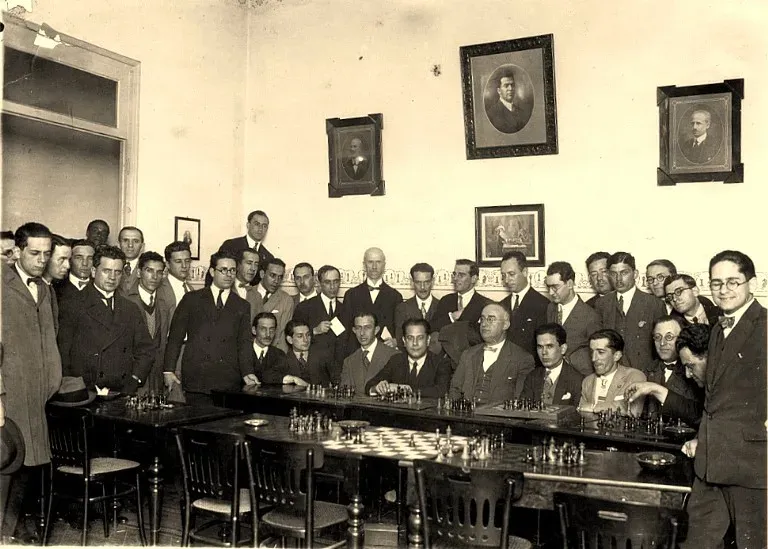
Capablanca giving a simultaneous exhibition at the São Paulo Chess Club
Capablanca Skips Alekhine and Still Takes Board-One Gold in 1939
The 1939 Chess Olympiad in Buenos Aires is remembered first for the war. Germany invaded Poland on 1 September, mid-event, and Capablanca played his last tournament and his last competitive game there, a detail that is easy to overlook.
Germany finished half a point ahead of Poland for its only Olympiad team gold to date. The two sides never actually met over the board: six matches went unplayed and were recorded as 2-2 draws, Germany v Poland among them.
A rivalry that never got its rematch
Capablanca had lost the 1927 world title match to Alekhine, and he spent the following years asking for a return. Alekhine kept finding reasons to decline. He defended against Bogoljubow in 1929 and 1934, lost to Max Euwe in 1935, and won the title back in 1937.
The two met in tournaments only rarely. Nottingham 1936 produced a Capablanca win, and at AVRO 1938 they drew one game and Alekhine won the other. That was their last tournament game against each other.
The round that wasn’t played
In Buenos Aires, Capablanca played board one for Cuba and Alekhine for France. In round twelve of the final group, on 14 September, they could have met. Capablanca sat out, and Alberto López Arce lost to Alekhine in 25 moves as the match ended 2-2.
Capablanca told the Argentine paper Crítica the next day that his reasons were purely personal. He had told the Argentine Chess Federation a week earlier. Neither Cuba nor France was in the hunt for overall victory.
Yet the title talks went on. On 16 September Capablanca wrote to federation president Augusto de Muro: “I am ready to play as soon as the match can be organised.”
Alekhine’s reply on 18 September was evasive. He noted that as a French army reserve officer he might be called up for interpreting duties.
The medal
Capablanca went unbeaten, scoring 11½ from 16 games (+7, =9, -0). Alekhine was also unbeaten and scored 12½ from 16 (+9, =7, -0), a full point more.
Only final-group results counted for individual medals, though. Capablanca made 8½/11 there and took board-one gold. Alekhine managed 7½/10 for silver.
The gold gave Capablanca one last, symbolic victory over his great rival.
His last tournament game was against Brazil’s Octávio Trompowsky, whose name is attached to 1.d4 Nf6 2.Bg5. Capablanca avoided opening theory and tactical complications, outplayed his opponent in the middlegame by simple means, and converted the endgame without difficulty. It was the style of countless earlier wins.
What came after
The war scattered the field. All five Germans (Eliskases, Michel, Engels, Becker and Reinhardt) stayed in South America.
Najdorf and Frydman stayed in Argentina, and Sulik later went to Australia. Tartakower, who played for Poland but lived in France, returned to join the Free French forces.
England’s team left early. Alexander, Milner-Barry and Golombek later worked at Bletchley Park on German military ciphers. The Chess Olympiad has rarely been so entangled with events outside the hall.
Capablanca played only simultaneous exhibitions and casual games afterwards. On 7 March 1942, aged 53 and long troubled by high blood pressure, he had a stroke at the Manhattan Chess Club in New York. He died the next morning at Mount Sinai Hospital.
- 1.
- 2.
- 3.
- 4.
- 5.
- 6.
- 7.
- 8.
- 9.
- 10.
- 11.
- 12.
- 13.
- 14.
- 15.
- 16.
- 17.
- 18.
- 19.
- 20.
- 21.
- 22.
- 23.
- 24.
- 25.
- 26.
- 27.
- 28.
- 29.
- 30.
- 31.
- 32.
- 33.
- 34.
- 35.
- 36.
Original source: ChessBase
Noticed an error in the article? Report it from here.