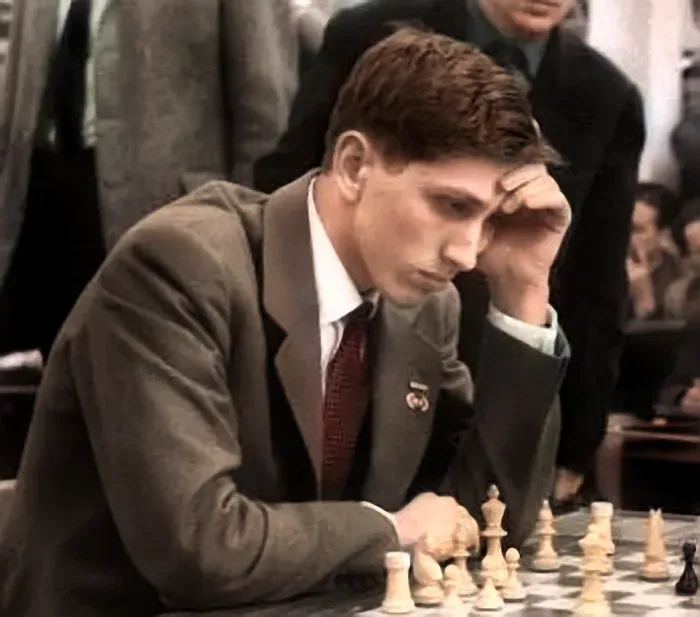
Bobby Fischer
Chess960 keeps every rule of chess except the starting position. The pieces on the back rank are shuffled before each game, and the pawns stay where they are. Black’s pieces mirror White’s.
Bobby Fischer proposed it in Buenos Aires in 1996, which is why it’s also called Fischer Random. His aim was to end the dominance of memorised opening theory and make players think from the first move.
The shuffle follows two rules. The bishops must stand on opposite-coloured squares, and the king must stand somewhere between the two rooks. That leaves exactly 960 possible starting positions, which is where the name comes from.
Castling still exists, and it ends in the usual place whatever the starting position. Castling kingside puts the king on g1 and the rook on f1. Castling queenside puts them on c1 and d1. As in normal chess, the king can’t castle out of, through or into check.
FIDE added the variant to its Laws of Chess in 2008. It held its first official Chess960 world championship in 2019, won by Wesley So over Magnus Carlsen, and Hikaru Nakamura won the second in 2022.
The variant has since been rebranded as Freestyle chess. Carlsen and the entrepreneur Jan Henric Buettner launched the Freestyle Chess Grand Slam Tour in 2025, and online events like Freestyle Friday now feed qualification for a Freestyle World Championship.
Its appeal to top players is the one Fischer saw: home preparation counts for far less. Players are on their own from the first move, which is exactly the point its backers make for it.
Original source: Wikipedia
Noticed an error in the article? Report it from here.