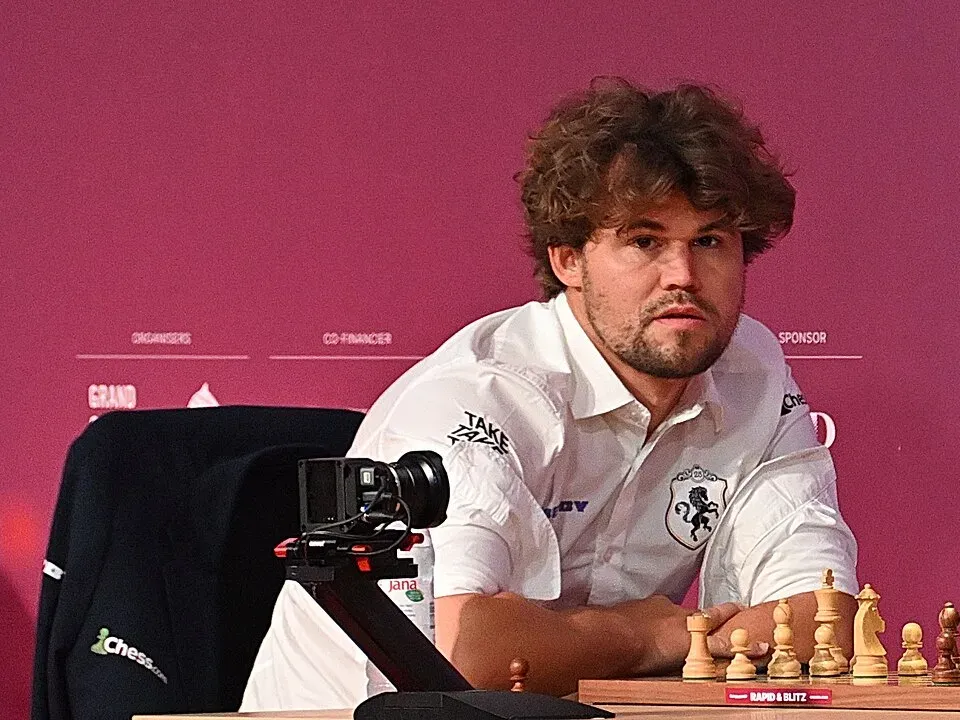
Magnus Carlsen
ChessBase Calls Total Chess Pilot a Crash After Carlsen Skips Games
A ChessBase commentary titled “Total Chess: A false start” argues that the pilot of the Total Chess World Championship has crashed. The trigger was Magnus Carlsen’s match against Vladislav Artemiev, where he played the blitz games and the fast classic game but skipped the rapid games.
The author, ChessBase editor André Schulz, goes on to take apart the format itself.
The skipped games
The commentary says Carlsen had already done this once. Against Bibisara Assaubayeva he built such a lead in the blitz and rapid games that he could not be caught, then did not show up for the semi-classical game. The author calls that unsporting and “completely unthinkable in other sports.”
The commentary’s explanation is about rating. Carlsen had no wins and one loss in the semi-classical games of the round-robin stage, and FIDE counts those 45-minute-base games as classical. A draw or loss against Assaubayeva, it says, risked pushing him below 2800 and perhaps costing him the world number one spot.
Other players, the commentary says, followed his lead and sat out the long games too. Its line: if the “boss” does it, the others will do it too.
The Artemiev match
Against Artemiev on Thursday, Carlsen led after the blitz. According to the commentary, he calculated that a win in the semi-classical game, worth 8 points, would be enough to win the match and would also help repair his classical rating. The commentary adds that Carlsen explained he wanted to save his energy for the longer game as well.
The commentary says the rules “apparently still contain major loopholes,” which Carlsen exploited.
FIDE sees a breach: its statement after the event says the regulations required every scheduled game to be played, and it has referred Carlsen’s conduct to its Ethics and Disciplinary Commission.
A format with “birth defects”
The commentary goes well beyond Carlsen. It questions the idea of mixing blitz, rapid and semi-classical games on one day, asking what the point is when there are already separate world championships for each.
It also says the shortened long game, 45 minutes instead of 90, gives players too little time for deep calculation, and that a full day across three time controls tires them.
It objects to FIDE rating the shorter games as classical, calling that “not a good idea,” and to the organisers’ plan for yet another rating list. The scoring is described as so complicated it takes “two semesters of chess tournament science” to follow.
Hans Niemann, who played in the pilot, said on X that the group stage should use the same format as the knockouts and that each blitz game should be worth 2 points, so that 8 points are available in each time control.
I wanted to share some thoughts on my experience competing in the Total Chess pilot, along with four format changes I hope the organizers will consider implementing for the full tour.
1. Consistent format: The group stage should use the same format as the knockout stage. It makes little sense to play an entirely different format in the groups, effectively disregarding the importance of rapid and blitz until the knockouts.
2. Equal weighting of time controls: Each blitz game should be worth 2…
The Grand Prix warning
The planned structure is a series of three tournaments with 24 players, then a final for the top four. The top two finishers would qualify for the Candidates, and the winner would be called World Combined Champion rather than Total Chess World Champion.
The author compares this with the FIDE Grand Prix series, which also fed the Candidates. After two or three events only a few players still had a chance, the rest lost interest, and FIDE had to fill fields from a reserve list. In the commentary’s telling, that distorted results and devalued the series, and FIDE was right to drop it.
The same risk applies here. If the qualification race narrows early, stars with no path to the top two may skip later events, and the incentive to sit out a game could spread further.
What comes next
The commentary’s closing view is that the organisers behind Norway Chess were right to hold a pilot, and can now investigate the crash and perhaps repair the format. It adds that it may simply be a total write-off. The organisers’ response to the criticism is the open question.
The same FIDE statement accused the tournament’s arbiters.
Chief Arbiter Anastasia Sorokina rejected FIDE’s statement that the arbiters had “effectively abdicated their responsibility,” writing on X in an open letter to Turlov and Anand that she “categorically” rejected what she called an unsubstantiated claim and was defending her ten arbiters’ professional reputations.
As Chief Arbiter of the Total Chess World Championship Tour Pilot 2026 in Budapest, I consider it my duty to defend the ten highly qualified arbiters whose professional reputations FIDE has publicly called into question. …
No participant appealed an arbiter's decision during the event, and I received no formal complaint about the team's conduct. …
I therefore formally demand that FIDE immediately withdraw its public allegations, publish a retraction through the same official channels used for the original statement, and publicly apologise to the arbiters' team for the damage already caused to their professional reputations.
Original source: ChessBase
Noticed a mistake? Report an error in this article.