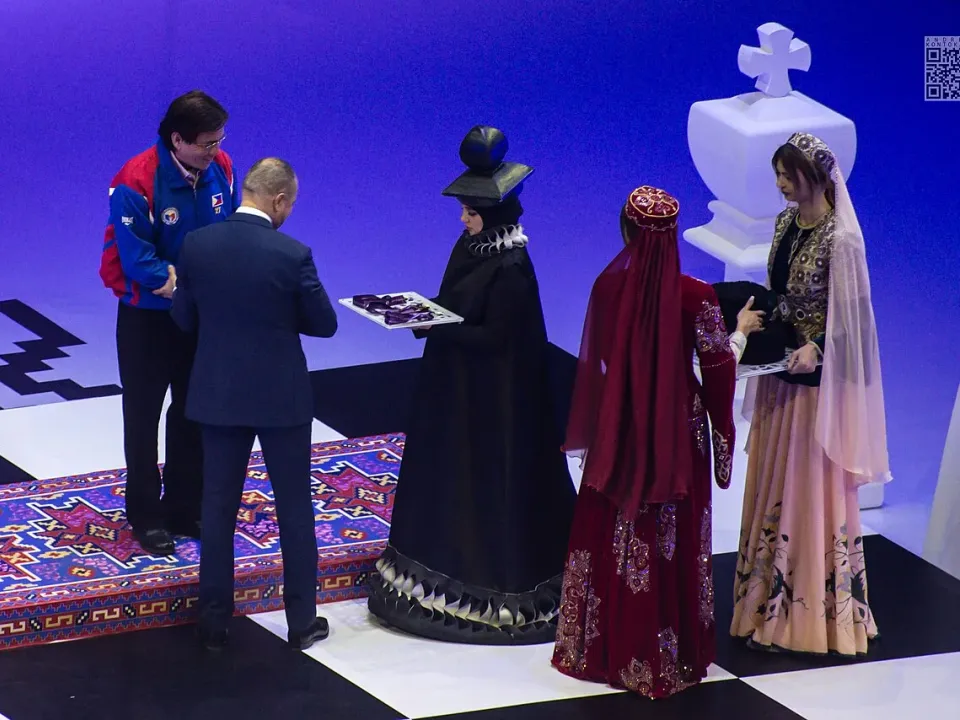
Eugenio Torre (left) receives his board medal at the 2016 Olympiad in Baku
Eugenio Torre turned 75 on 4 November, and ChessBase marked the birthday of the man who became the first Asian to earn the grandmaster title, in 1974. Born on 4 November 1951 in Iloilo City, on the island of Panay, he was the seventh of ten children.
What stands out in the biography is how little formal help he had. His lawyer father taught all the children chess, and the family made pieces from leather scraps supplied by a shoemaker. Torre had no coach and learned from a few instructional books and from playing through games in Chess Informant.
A self-made route to the top
Progress came quickly anyway. He was playing junior events at nine against much older rivals, and he was Philippine junior champion at sixteen.
At the 1969 World Junior in Stockholm he finished fourth in his preliminary group, won by Anatoly Karpov, then took the B final. In 1971 he was fourth again, ahead of Rafael Vaganian.
He gave up an economics degree after two years because it could not be combined with chess. That was a real bet in a country with little professional chess, and it needed patrons.
Florencio Campomanes, later FIDE president, was among those who funded his travel. In 1972-73 Torre lived in Madrid to cut the cost of reaching European events, on a monthly allowance of US$250.
The Olympiad record
Torre first played for the Philippines at the 1970 Olympiad in Siegen and kept going through Baku in 2016. He missed only Dresden in 2008, which leaves him with 23 appearances, the all-time record. He won individual board bronze in Nice (1974), Valletta (1980), Dubai (1986) and Baku (2016).
The Nice result also brought the grandmaster title, two years after his international master title in 1972. Torre also won individual gold on board one four times at the Asian Team Championships.
Interzonals and the Candidates
His best shot at the world title route came at the 1982 Interzonal in Toluca, where he shared first with Lajos Portisch. That made him the first Asian in the Candidates matches, where Zoltan Ribli beat him in the quarterfinals.
He came close again in 1985, sharing 4th-6th. A playoff with Nigel Short and John van der Wiel for a Candidates place followed, and Torre finished last. Zagreb 1987 brought seventh place and another miss.
Winning the elite
Torre could beat the best. In 1976 he won a four-player event in Manila ahead of Karpov, Ljubojevic and Browne.
In 1984 he beat Andrey Sokolov 2-1 in the USSR v. Rest of the World match.
He also won the Marlboro Chess Classic in Manila in 1977 and 1979, and the Jakarta Internationals in 1978 and 1979. National titles came as late as 2001, 2002 and 2014, and in 2017 he scored a perfect 9/9 at the Asian Senior Championship.
Fischer’s friend
Torre met Bobby Fischer at the Siegen Olympiad in 1970. After Fischer left public life following 1972, he spent time hiding in the Philippines, and the friendship grew there.
In 1992 Torre was Fischer’s second for the rematch with Boris Spassky and played training games against him beforehand. In the early 2000s the two lived in the same residential complex in Baguio City.
Few players earned that kind of trust from Fischer, which is an unusual line on any résumé.
Legacy at home
Torre was named Philippine Sportsman of the Millennium in 2000 and entered the World Chess Hall of Fame in 2021. His success helped build chess in the Philippines, which hosted the 1978 Karpov-Korchnoi World Championship match and the 1990 Olympiad.
In 2023 he opened a small personal museum in Marikina City for his trophies and memorabilia. That year he also became national coach, and he travelled with the Philippine team to the 2024 Olympiad in Budapest.
Torre's win over Karpov in Manila, 1976
- 1.
- 2.
- 3.
- 4.
- 5.
- 6.
- 7.
- 8.
- 9.
- 10.
- 11.
- 12.
- 13.
- 14.
- 15.
- 16.
- 17.
- 18.
- 19.
- 20.
- 21.
- 22.
- 23.
- 24.
- 25.
- 26.
- 27.
- 28.
- 29.
- 30.
- 31.
- 32.
- 33.
- 34.
- 35.
- 36.
- 37.
- 38.
- 39.
- 40.
- 41.
- 42.
- 43.
- 44.
- 45.
- 46.
- 47.
- 48.
Original source: ChessBase
Noticed an error in the article? Report it from here.