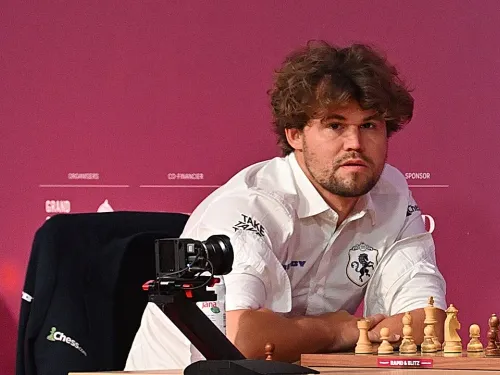
Michael Adams
In round six of the Samarkand Olympiad, Michael Adams beat Etienne Bacrot in a game that began 1.e4 c5 2.Nf3 d6 3.Bc4. That is a setup theoreticians long treated as something close to a joke, and ChessBase compares it to an “underarm serve” in tennis. Adams’s win offset Gawain Maroroa Jones’ loss to Marc’Andria Maurizzi, and England and France drew 2-2.
An opening that lived at amateur level
The idea is simple. Instead of entering the long theoretical lines of the Open Sicilian with d2-d4, White develops as in the Modern Variation of the Italian Game: Bc4, d3, castling. For decades this was seen as unsound against 1…c5, because White doesn’t contest the centre with d2-d4.
ChessBase notes that the setup was still played regularly by amateurs. It suits online players who want a “repertoire” without memorising much: 1.e4, 2.Nf3, 3.Bc4, 4.0-0, 5.d3 works against 1…e5, 1…d6, 1…g6, 1…Nc6, 1…b6 and 1…c5 alike. Only 1…Nf6 and 1…d5 demand real care.
The London System precedent
The comparison the source draws is the London System. About 20 years ago, Bf4 without c2-c4 after 1.d4 d5 was mocked as an “old man’s opening.” Opponents who actually faced it found the venom, and it is now practically part of most top players’ repertoires.
The Sicilian version is following a similar path, though it is further behind. Magnus Carlsen plays 3.Bc4 regularly in online blitz, at least. The logic is hard to resist: if the world’s best player trusts it, why keep it out of classical chess?
Why top players want it
Part of the answer is fatigue. Grandmasters play huge amounts of internet blitz, and repeating well-known theory gets dull, so irregular lines get tested. A quiet setup also has a practical value at a team event: it takes the game out of the opponent’s preparation.
That seems to be what Adams was after. He had no interest in a theoretical discussion with Bacrot, who had Black, in the long Sicilian lines. For a long time, very little happened in the game. When it turned sharp, though, White’s setup turned out to hold many tactically venomous possibilities.
What it means
One win does not rehabilitate an opening, and Bacrot’s side of the story is not in the source. But Adams is one of the most respected opening technicians of his generation, and he chose this move in a classical Olympiad game with team points at stake. A player of his experience is unlikely to pick it just for the novelty.
It is worth watching whether others copy it at the board in later events. Once the London became a fixture, opponents had to prepare for it. The same pressure may now be building around 3.Bc4.
Original source: ChessBase
Noticed an error in the article? Report it from here.