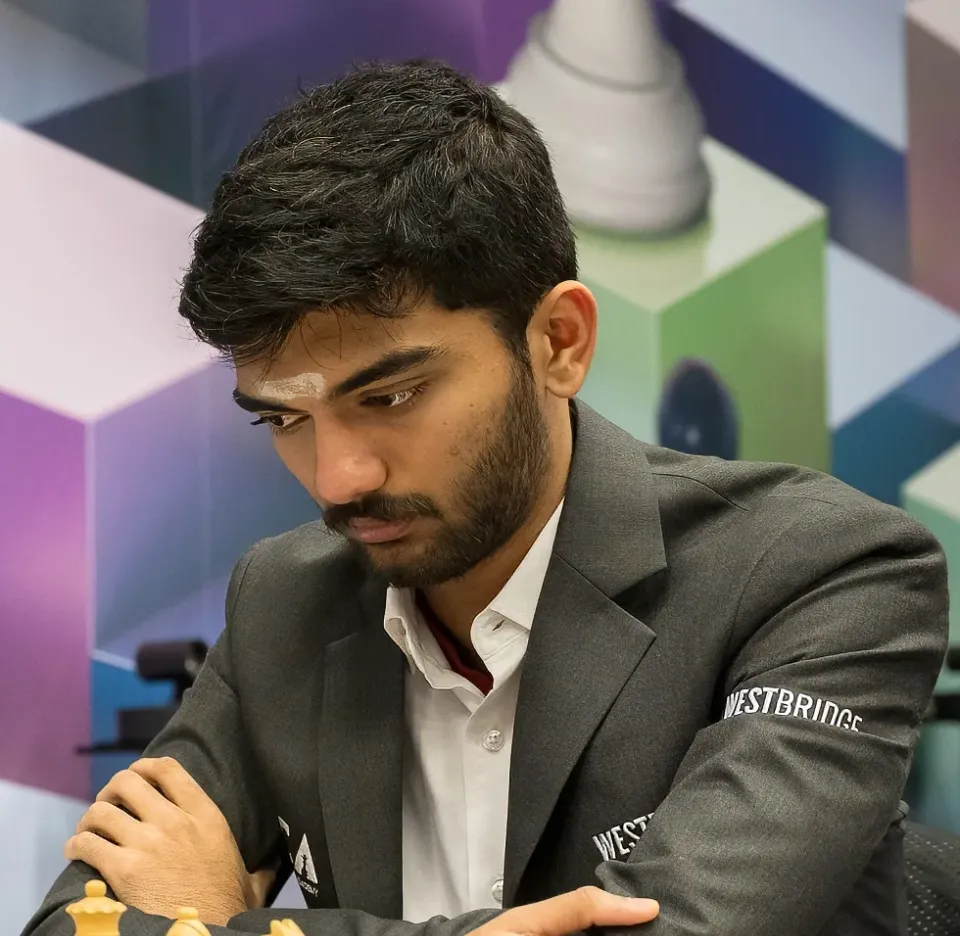
Gukesh Dommaraju
Round two of the 46th Chess Olympiad in Samarkand mostly went to script, but one result stood well outside it. El Salvador, seeded 94th in the field, beat Cuba, seeded 44th, in a result that had almost nothing to do with the pecking order on paper.
The upset came down to two individual results on the lower boards. El Salvador’s FM Carlos Morales, rated 2244, beat Cuban GM Jorge Roberto Elias Reyes, rated 2505, on board one, and FM Santiago Jose Guevara Ruiz, rated 2160, beat Cuban GM Lelys Stanley Martinez Duany, rated 2440, on board three, both by real margins rather than a stolen draw or a late blunder from an otherwise-winning position.
Cuba salvaged what it could elsewhere. GM Dylan Isidro Berdayes Ason won on board two, and GM Ermes Espinosa Veloz drew on board four, but the two lower-board upsets were enough to hand El Salvador the match 2½-1½.
Chess.com’s own recap put the gap in team terms: El Salvador fielded an all-FM lineup averaging 2165 against a Cuban team averaging 2467, a roughly 300-point gap by that measure. Beating two GMs from a position like that is a real result, not a fluke.
Cuba’s Olympiad campaigns have been a recurring thread this cycle. Cuba’s unbeaten run has been tracked closely as the team chased a clean scoresheet through the early rounds, which makes a loss to a team nearly fifty places below them in the seedings sting more than a routine draw would.
Everywhere else, the favorites held, even if it wasn’t always comfortable. Uzbekistan, the United States, India, and the Netherlands all won their round two matches, but the source description makes clear none of it was smooth sailing for the top seeds.
India’s win over Indonesia carried its own subplot. Gukesh, the reigning world champion and one of India’s board one options, dropped below a 2700 live rating in the process, a symbolic line for a player of his stature even as his team collected the full match points.
It’s a reminder that India’s Olympiad strength right now isn’t resting on any single player carrying the board. The squad’s depth has been a running theme of this event, echoed in India’s bench holding up even when a top board result goes sideways. A dip under 2700 in live rating for one player matters far less to the team’s chances when the supporting cast is winning matches regardless.
The broader shape of round two also fits a pattern the Olympiad has shown all week: favorites grinding through tougher-than-expected matches rather than steamrolling lower seeds. That’s partly a function of just how large this year’s field is. Samarkand’s Olympiad already broke the record for team entries, and a bigger field means more federations capable of springing exactly the kind of result El Salvador produced against Cuba.
For El Salvador, the win is a signature result regardless of what happens the rest of the way, the kind of scoreline a small federation can point to for years.
For Cuba, the loss doesn’t end their tournament, but it does complicate any path back to the top of the standings, and it puts real pressure on the remaining rounds to make up ground against teams they’d normally be expected to beat.
The next rounds will show whether El Salvador’s result was a one-off shock or the start of a genuine run, and whether Cuba can regroup before the seeding gaps start working against them in must-win matches instead of for them.
Open standings after Round 2 of 11
| # | Team | W–D–L | Match Points | Board Points |
|---|---|---|---|---|
| 1 | Poland | 2–0–0 | 4 | 8 |
| 2 | Croatia | 2–0–0 | 4 | 8 |
| 3 | Lithuania | 2–0–0 | 4 | 8 |
| 4 | Belarus | 2–0–0 | 4 | 8 |
| 5 | Iceland | 2–0–0 | 4 | 8 |
| 6 | Uzbekistan | 2–0–0 | 4 | 7.5 |
| 7 | Germany | 2–0–0 | 4 | 7.5 |
| 8 | France | 2–0–0 | 4 | 7.5 |
| 9 | Armenia | 2–0–0 | 4 | 7.5 |
| 10 | Iran | 2–0–0 | 4 | 7.5 |
Original source: Chess.com
Noticed an error in the article? Report it from here.