Gukesh Dommaraju
Cuba’s run at the top of the 3rd FIDE Chess Olympiad for People with Disabilities is over. Round 5 in Samarkand handed Cuba its first match defeat of the tournament, a result that reshapes the standings just as the main 46th Chess Olympiad opens in the same city.
It’s a sharper turn than it might look on paper. The Chess Herald noted Cuba’s unbeaten start earlier in the event in Cuba Stays Perfect as the Disability Olympiad Nearly Doubles, when the field was still swelling toward its record size. Five rounds later, that perfect record is gone, and gone against the top seed.
The match itself was tight. Marcin Molenda drew Carlos Larduet Despaigne, Aleksander Czerwonski split the point with Hector Luis Fuentes De Feria, and Julia Salamon and Idalis Batista Rivera also drew. It came down to Board 2, where Pawel Piekielny beat Pedro Morales Romero to seal a 2½–1½ win for Poland.
The Czech Republic seized the same opening. Three games against Israel ended level, but Anna Ryvova’s win over Aleksandra Aleksandrova on Board 4 gave the Czechs an identical 2½–1½ scoreline, enough to pull them level with Poland at the top on 9 match points. The two co-leaders now meet each other directly in Round 6, a fixture that will settle who actually leads outright.
Behind them, the chase pack tightened too. The Philippines beat Croatia 2½–1½, IBCA beat Germany by the same margin, and the USA beat Argentina 3–1. Uzbekistan 1 defeated Serbia 2½–1½, India edged IPCA 2½–1½, while Ukraine beat Belarus 3½–½ and Kazakhstan beat Bangladesh by the same score. After five rounds, the Philippines, Cuba and IBCA sit on 8, with the USA, Uzbekistan 1 and India next on 7.
What makes this stretch of the tournament distinct is the overlap now happening on the ground. With the Opening Ceremony of the 46th Olympiad also held that day, the two events are running side by side in Samarkand for the first time, and it’s visibly changing the experience for competitors.
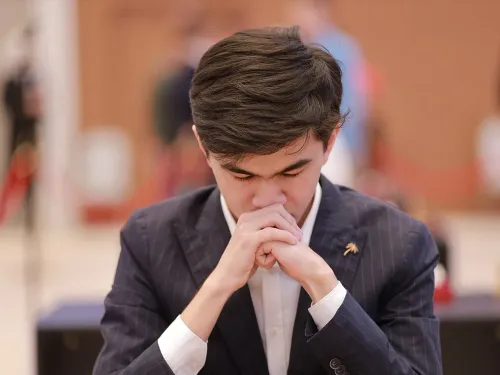
Panama’s Jesus Camilo Osorio, playing his third Disability Olympiad at 42, described crossing paths with Vassily Ivanchuk near the entrance and then spotting World Champion Gukesh D through a door: “I have to take a picture with this guy.”
He said the reaction around Gukesh reminded him of a pop star, joking that “everybody wanted to take a picture with him.”
That kind of proximity is new for a tournament that started far smaller in Belgrade, a history The Chess Herald has traced in Samarkand’s Disability Olympiad Echoes Belgrade’s First Steps. Osorio’s own framing of the growth fits that trajectory: he said the event keeps improving because more teams mean more connections carried on after the closing ceremony.
The human stories running alongside the standings say something too. Bangladesh’s Nurnahar Tonima, the only woman on her team, plays on a Braille board after losing her sight, having taken up the game in 2017 under a coach who is also visually impaired.
Her own summary of the format cuts through any question of whether the adapted equipment changes what chess actually is: “Chess is very intellectual. It’s not a barrier.”
Round 6 now carries the real weight. Poland and the Czech Republic, both unbeaten through five rounds, play each other directly with the sole lead on the line.
Original source: FIDE
Noticed an error in the article? Report it from here.