Ashutosh Kumar Singh
Cuba is the only team left with a perfect record at the 3rd FIDE Chess Olympiad for People with Disabilities, and it got there the hard way. On Monday in Samarkand, Cuba beat Israel 2½–1½ in a direct clash between two of the tournament’s three unbeaten teams, stretching its run to four wins from four matches and eight match points overall.
The Czech Republic, the third team that had entered Round 4 unbeaten, didn’t survive either. Germany held them to a 2–2 draw on board two. Poland produced the round’s most lopsided result, thrashing India 4–0 to jump into second place on tiebreaks with seven match points.
Elsewhere among the leading pack, IBCA edged Ukraine 2½–1½, the Philippines routed Egypt 4–0, Croatia beat Spain 2½–1½, and Argentina overcame Mongolia by the same 2½–1½ margin. After four rounds, Israel, the Czech Republic, Germany, Croatia and the Philippines are bunched together on six points apiece, still within reach of the lead.
What makes this year’s event notable isn’t just Cuba’s clean sheet, it’s the scale it’s happening at. Chief Arbiter Nebojsa Baralic, who also ran the very first edition of this Olympiad in Belgrade in 2024, watched that tournament field 26 teams. Samarkand has drawn a record 41, a jump he described simply: “more players and more duties, more arbiters, more volunteers, more assistants.”
That growth trajectory is the real historical parallel worth drawing here. Belgrade proved the format could work at all.
Samarkand is proving it can scale, and scaling a disability-inclusive Olympiad means solving logistics problems that a standard team event never faces, from adapting boards and tables on the morning of each round to lining up support in English, Russian, Arabic and Spanish.
The Chess Herald covered that first edition’s own growing pains in Samarkand’s Disability Olympiad Echoes Belgrade’s First Steps, and the numbers from this week show the curve hasn’t flattened.
Nowhere was that logistical weight more personal than in the match between Bangladesh and Uzbekistan 3. Baralic spent roughly two and a half hours as an assistant to Abbas, an Uzbek player with severe physical disabilities who cannot move his hands, legs, or speak.
Abbas communicated every move through glances, which Baralic interpreted and then executed on the board and clock himself. “I cannot forget that for all my life,” Baralic said of the smile he saw when he got a move right.
Other players are navigating the same event through entirely different senses. Tuan Kiet Dao of Vietnam, who is blind, reads the position by touch on a board where black pieces carry a tactile marking and dark squares sit slightly raised above light ones. He started playing around age 12 and once skipped school for tournaments, telling FIDE, “I will prioritize chess over study.”
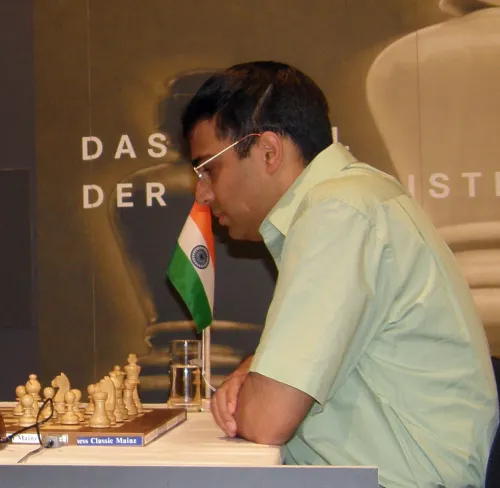
For Ashutosh Singh of Team India, Samarkand marks a different kind of milestone. Despite three gold medals at the All India University level and a World University appearance in Kuala Lumpur, this is his first Olympiad for Players with Disabilities, reached through India’s national qualifying competition.
Round 5 puts the top of the standings straight back under pressure. Cuba faces second-placed Poland on the top board, Israel meets the Czech Republic, and Germany takes on IBCA, while Croatia and the Philippines square off in a battle of six-pointers.
With three rounds left after that, Cuba has the only gap at the top of the table. Whether it survives another direct test against the field’s next-best team is the question the rest of the week will answer.
Original source: FIDE
Noticed an error in the article? Report it from here.