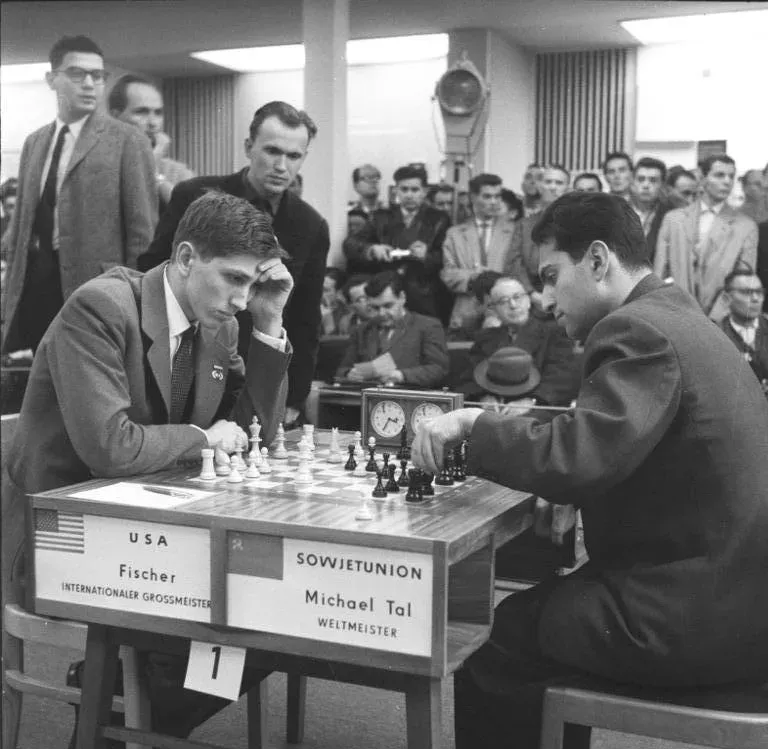
Bobby Fischer (left) against Mikhail Tal at the 1960 Olympiad in Leipzig
Fischer's Game of the Century at 70, and the Magazine That Never Printed It
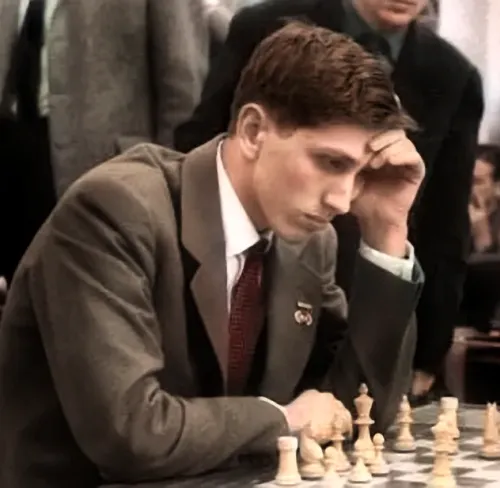
On 17 October 1956, a 13-year-old from Brooklyn sacrificed his way through Donald Byrne’s position at the Marshall Chess Club. In the October 2026 issue of CHESS magazine, John Henderson recalls the game that made Bobby Fischer famous, seventy years to the day after it was played.
It was round 8 of the third Lessing J. Rosenwald Trophy. Hans Kmoch later billed it the “Game of the Century” in the December 1956 issue of Chess Review, and the name stuck.
A game Fischer left out of his own anthology
Byrne was no pushover. He was a professor at Penn State, an eventual IM and the 1953 US Open winner. Henderson notes he was the younger, more affable of the Byrne brothers, with Robert going on to become a grandmaster and Candidates player.
Even so, Byrne believed right up to 17…Be6!! that he stood better. He never saw the depth of what was coming.
Oddly, Fischer left the game out of his 1969 collection, My 60 Memorable Games. His reasoning, as Henderson tells it, was typically systematic: he had already published it with light notes in his 1959 book, Bobby Fischer’s Games of Chess, which held 34 early games. Deeper annotations would have sold well, but he saw no need to repeat himself.
A rapid rise through 1956
Henderson sketches how fast Fischer was moving that year. He started 1956 as a gifted amateur and ended it as a solid master. IM John Donaldson, in an email to Henderson, credits part of that to Fischer joining Jack Collins’ Hawthorne Chess Club in June.
The results followed. Fischer won the 11th US Junior Championship in Philadelphia and made his first magazine cover. He then scored 8½-3½ without a loss at the US Open in Oklahoma City (17-28 July), tying for fourth to eighth.
Next came his first overseas event, the Canadian Open in Montreal (25 August to 2 September). He finished eighth to twelfth, a point behind joint winners Larry Evans and William Lombardy. His host, tournament director William Hornung, told The Montreal Star: “That boy! He even plays expert chess while he’s sleeping.”
Evans drove him home to New York and later wrote that Fischer talked about chess for all six hours, even ignoring Evans’ wife.
The tournament itself
The Rosenwald ran 7-24 October. It was expanded to twelve players so the new junior champion could take part, and Fischer got time off school. His 4½/11, eighth to tenth, was modest. Sammy Reshevsky won, in an event also marked by a controversial double default.
Fischer’s tournament result mattered less than that one game. Before it, he was untitled and little known beyond New York. Soviet magazines carried the game and began compiling a “Fischer file.” Just over two years later he was in the Candidates as the world’s youngest grandmaster.
The magazine that never ran it
The most unusual part of Henderson’s piece is an admission. CHESS never published the game. The only trace in its archives is a one-paragraph item, “New York’s New Chess Prodigy,” in the 9 November 1956 issue, promising the game “later.”
Henderson, his editorial team, John Saunders and historian Alan McGowan searched the 1956-59 indexes and even Leonard Barden’s columns. They found nothing.
Henderson’s guess is bad timing for founding editor B.H. Wood, who was finishing a large 1956 Moscow Olympiad report, then the Christmas issue, then the Hastings report. That event was jointly won by Svetozar Gligoric and a young Bent Larsen, making his debut there. Henderson is sure the game appeared at some point in the 1960s or 70s, but not in the 1950s as promised.
There was also a misprint in Chess Review. The December issue paired the Fischer cover photo with a page reference that actually led to Smyslov-Pachman from the 1956 Moscow Olympiad.
A bonus from the DeLucia collection
As atonement, CHESS runs the game with extensive annotations by Henderson. Collector David DeLucia, whose library of chess books, manuscripts and ephemera is unmatched, owns Fischer’s original handwritten scoresheet of the game.
His Fischer holdings also include a bible, a wristwatch, a wallet and the galley proofs of My 60 Memorable Games, along with a manuscript that originally held only 52 games.
- 1.
- 2.
- 3.
- 4.
- 5.
- 6.
- 7.
- 8.
- 9.
- 10.
- 11.
- 12.
- 13.
- 14.
- 15.
- 16.
- 17.
- 18.
- 19.
- 20.
- 21.
- 22.
- 23.
- 24.
- 25.
- 26.
- 27.
- 28.
- 29.
- 30.
- 31.
- 32.
- 33.
- 34.
- 35.
- 36.
- 37.
- 38.
- 39.
- 40.
- 41.
Original source: ChessBase
Noticed an error in the article? Report it from here.