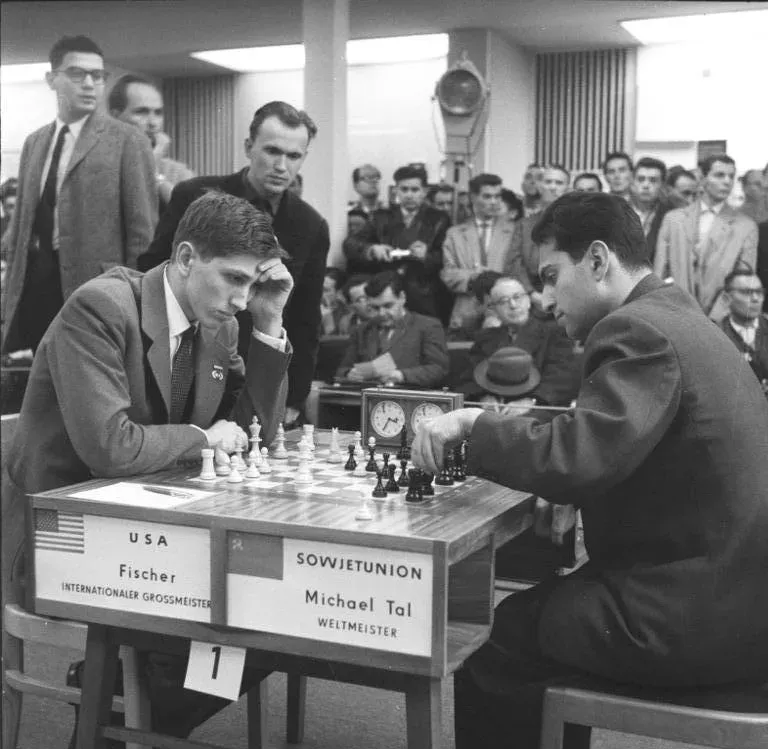
Mikhail Tal (right), then world champion, against Bobby Fischer at the 1960 Olympiad in Leipzig
Mikhail Tal was born in Riga on 9 November 1936, so Monday was his 90th birthday. ChessBase marked it by reprinting a portrait from the magazine Karl, and the picture it draws is of a man who seems to have been built for attacking chess.
A life without conventions
His widow, Angelina Tal, put it this way: “Misha was a genius. That is why he had this kindness. […] But he was not a particularly easy person.”
The details bear that out. Tal never owned a wallet, gave money away without hesitation and, by the portrait’s account, lived for chess alone. At one point he shared a flat with his ex-wife, their son, his new girlfriend, his mother and his brother.
Angelina recalled that he usually rose at six and spent almost the whole day on chess. He had skipped two years at school and was at university at 17.
A fast rise
Tal learned the game at seven and was good, but not a prodigy. In 1949 he met Alexander Koblenz, who became his coach and confidant for life. After that, the climb to the world elite was breathtakingly quick.
He was not even a full-time player at first. In 1958 he passed his state examination in Russian Language and Literature and briefly worked as a trainee teacher.
In 1960 he qualified on his first attempt as challenger to Mikhail Botvinnik, the disciplined patriarch of Soviet chess. Tal won the match 12½-8½ and became the youngest world champion up to that time.
The return match
Botvinnik used his right to a rematch and prepared carefully. Tal, by contrast, seemed not to take it seriously, and Koblenz could not get him in the right frame of mind.
Tal had also written a candid book about the 1960 match, describing his strategy and feelings. It is a gift to readers, but the portrait notes it was ideal preparation for Botvinnik too.
Tal was in poor health in 1961, and the match was not postponed. He lost 8-13, becoming the youngest former world champion, a title the portrait says he wore with pride.
Not a one-year wonder
It is tempting to think Tal never recovered. The record says otherwise. He won the Soviet championship six times, something only Botvinnik also achieved.
In 1972-73, with his play calmer, he went 86 consecutive games unbeaten against strong opposition. That is a very different picture from the reckless sacrificer of legend.
He was also a gifted writer and broadcaster. He edited the Latvian magazine Sahs for ten years, and his book The Life and Games of Mikhail Tal, structured as an interview with himself, is regarded by many as one of the best chess books ever. Politics and private life are left out of it.
Soviet friction and a hard end
Some officials harassed him, and he was occasionally refused permission to travel abroad. The portrait suggests he probably agreed to second Karpov in the match against Korchnoi because it let him play in Western tournaments again.
His lifestyle caught up with him. He smoked and drank heavily, and was for a time addicted to morphine. He died on 28 June 1992, aged 55, in a Moscow hospital after an incorrectly performed operation.
Even so, he kept playing. At the end of April 1992, in Barcelona, he beat Lautier in a brilliant game, sacrificing a piece in the opening to keep the black king in the centre.
In his last blitz tournament, shortly before the operation, he beat Garry Kasparov once more. He finished third behind Kasparov and Bareev, ahead of Smyslov, Dolmatov and Beliavsky.
Tal - Lautier, Barcelona 1992, two months before Tal died
- 1.
- 2.
- 3.
- 4.
- 5.
- 6.
- 7.
- 8.
- 9.
- 10.
- 11.
- 12.
- 13.
- 14.
- 15.
- 16.
- 17.
- 18.
- 19.
- 20.
- 21.
- 22.
- 23.
- 24.
- 25.
- 26.
- 27.
- 28.
- 29.
- 30.
- 31.
- 32.
- 33.
- 34.
- 35.
- 36.
- 37.
- 38.
- 39.
- 40.
- 41.
- 42.
- 43.
- 44.
- 45.
- 46.
- 47.
- 48.
- 49.
- 50.
- 51.
- 52.
- 53.
- 54.
- 55.
- 56.
- 57.
- 58.
- 59.
- 60.
- 61.
- 62.
Original source: ChessBase
Noticed an error in the article? Report it from here.