Frederik Svane
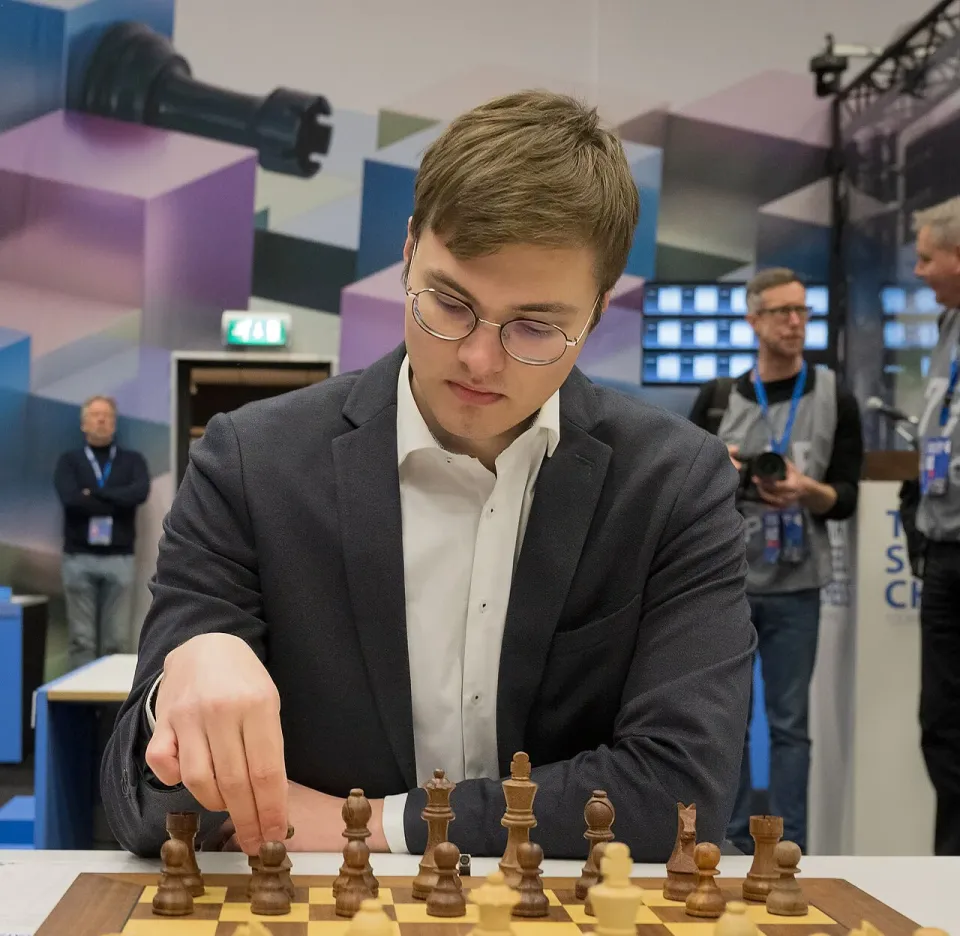
Frederik Svane’s second Olympiad gold puts him alongside a single predecessor: before him, only Dr Robert Hübner had won two individual golds for Germany. His 2026 gold came on board three, and across his two Olympiads he is unbeaten: thirteen wins and seven draws. Svane is 22, which leaves a lot of room for the count to grow.
The comparison is instructive because the two golds were won in different ways, and the medal rules themselves have been rewritten many times.
Hübner’s two golds
In 1972 in Skopje, Hübner scored 15 points from 18 games, 83.3 percent, to take gold on board one.
Eighteen years later, in 1990 in Novi Sad, he scored 7 from 10 on board one. That left him “only” fifth in the board-one standings. His performance rating of 2734 was the best of any Olympiad participant, though, and that earned him a second gold.
How the rules kept changing
At the first official Olympiad, London 1927, there was no fixed board order, and the best individual results in the whole tournament were rewarded. A similar system ran in 1928. In Hamburg in 1930 the absolute number of points counted.
That is why Akiba Rubinstein, Poland’s board one, won gold with 15/17 in 1930. Under a percentage rule, Alexander Alekhine would have taken it with 9/9 on France’s first board.
From 1931 percentage score became decisive, with special rules added from time to time. From 1984 through 2006, three extra medals went to the best tournament performance ratings across the whole field, on top of the board medals. A player could therefore leave with three medals: team, board and rating.
John Nunn did exactly that in Thessaloniki in 1984. He won team silver with England, gold on board two with 10/11, and gold for the best performance rating of the tournament, a TPR of 2868.
In 2008 the overall rating classification was dropped. Since then the best performance rating on each individual board counts. Hübner’s 1990 gold is a reminder that a performance-rating prize can reward a result the percentage table ranks lower. If you want to know how that figure is calculated, our explainer on what a chess rating actually measures is a good start.
The national record belongs to someone else
According to the OlimpBase database, neither Svane nor Hübner holds the German record for board prizes. That belongs to Lothar Schmid, the Karl-May-Magazin publisher and arbiter, who won silver on board two four times: Dubrovnik 1950, Helsinki 1952, Lugano 1968 and Siegen 1970.
The comparison covers every player who represented Germany from 1927 onward: the Weimar Republic, the Nazi era, West Germany, East Germany and the reunified country.
Schmid’s four silvers span two decades, which suggests consistency rather than one great event. Svane has a long runway if he wants to match that. The next Olympiad is in Abu Dhabi in 2028.
At the ChessBase stand in Samarkand, Svane was seen showing Bahne Fuhrmann his round-seven win over Isik Can of Türkiye.
Original source: ChessBase
Noticed an error in the article? Report it from here.