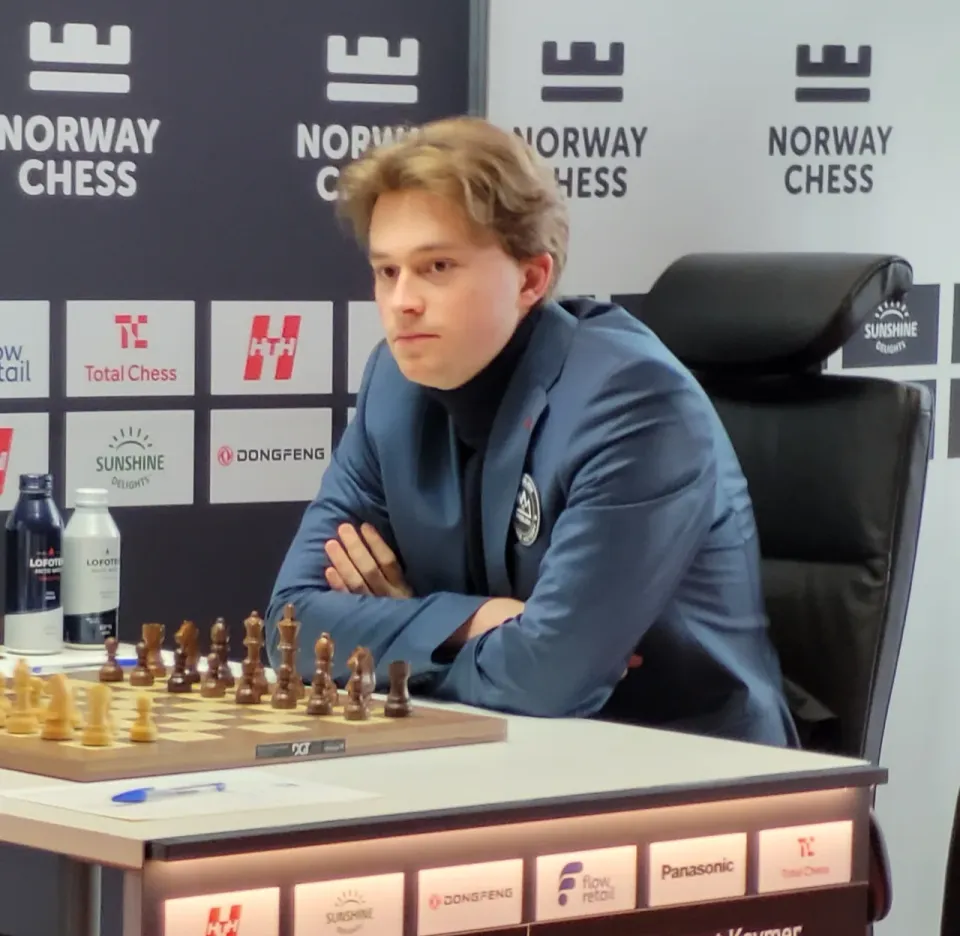
Vincent Keymer
The Total Chess pilot tournament in Budapest, running 10 to 20 November, is built to be more than an exhibition. ChessBase walked through the format and cautioned that it may not have reproduced every rule correctly, so the details below come with that caveat.
Twenty-four elite players, Vincent Keymer among them, will play blitz, rapid and “Fast Classic”, a shortened classical format at 45 minutes plus 30 seconds per move. The prize fund is US$650,000, with $80,000 to the winner.
A blitz opener that keeps mattering
Day one is a nine-round Swiss blitz at 3+2 for all 24 players. It looks like a warm-up, but its standings are the tiebreak for the group stage that follows. Anyone who has watched a Swiss tournament decided on tiebreaks knows how much that can matter.
From 11 to 15 November the field splits into four groups of six, double round-robin, Fast Classic games. A win is worth three points, a draw one, a loss none.
Everyone plays to the end
After the groups, six separate knockouts form by finishing position. The four group winners play for places 1 to 4 and the overall title. The runners-up play for 5 to 8, and the four sixth-placed players play for 21 to 24.
So one bad group can end a title bid but not a tournament. All 24 remain in action until 20 November.
Where the scoring gets odd
Knockout semifinals are on 17 and 18 November. Each match is two daily mini-matches of seven games: four blitz (3+2), two rapid (15+10) and one Fast Classic (45+30).
Points are weighted heavily toward slower chess. Blitz pays 1 for a win and 0.5 for a draw. Rapid pays 4 and 2, and Fast Classic 8 and 4, so 20 points are available each day.
The score resets to zero on day two. Win both days and you advance. If one day is drawn, the other decides it.
The Armageddon trap
If each player wins one day, or both days are drawn, the aggregate does not decide the match. An Armageddon game does.
ChessBase’s example: a player wins day one 16-4 and loses day two 9-11. That is 25-15 overall, yet an Armageddon is still required.
The player with the higher total picks the colour. If totals are level, a bidding procedure sets it. It is a format that can punish the player who played the better two days, which is probably the point if the goal is drama.
What Budapest is, and is not
Nobody becomes champion here. The event is a pilot for the Total Chess World Championship Tour, starting in 2027, and it awards no Tour points. The top three finishers earn a place in the first 2027 Tour event if they have not qualified otherwise.
The Tour has three 24-player tournaments, with points by finishing place and bonuses for repeat wins. The top scorer gets the “Golden Rook” but not the title. The four best on the Tour meet in a final event, where the two semifinal winners play four matches in two-day “Races”.
If the Races split, two blitz games decide it, then Armageddon, and the winner becomes “FIDE World Combined Champion 2027”.
The Candidates twist
The top two in the 2026-2027 Tour standings earn places in the 2028 Candidates. That is based on Tour standings, not the final. So the final’s winner could miss the Candidates by finishing third on the Tour.
Organisers say final-event rules may change after Budapest. Whether that simplifies things is an open question.
Original source: ChessBase
Noticed an error in the article? Report it from here.