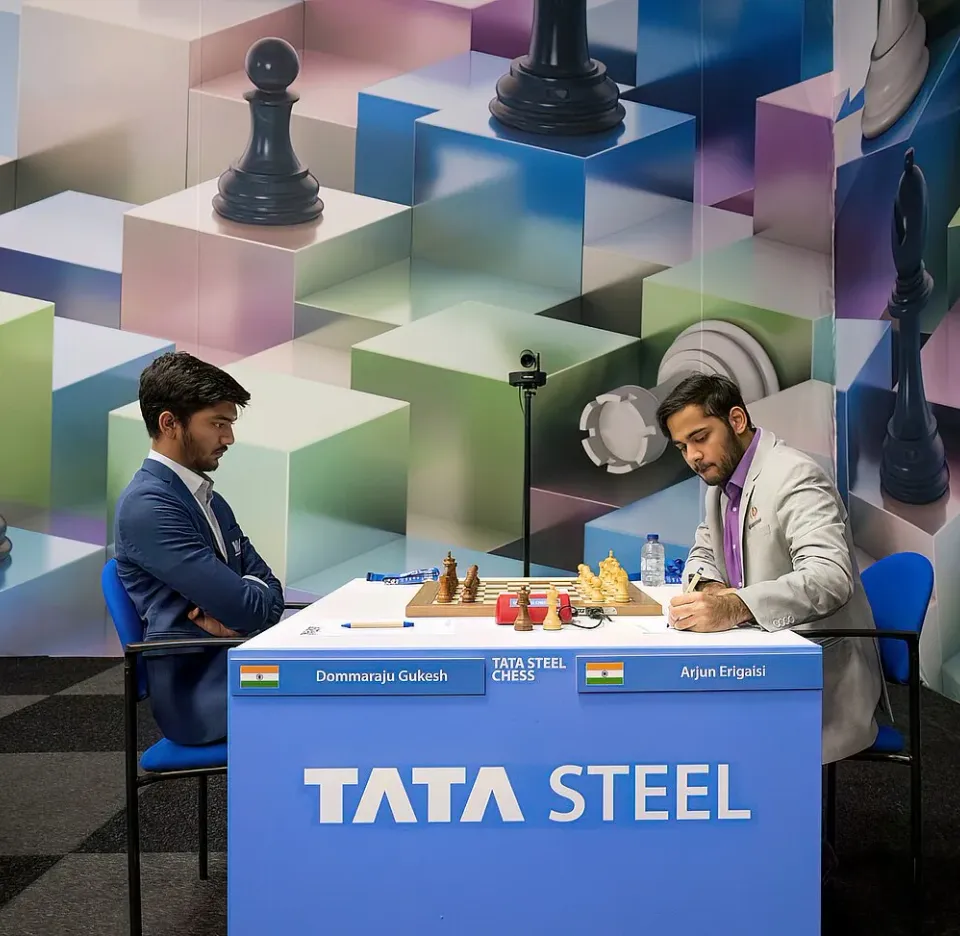
Gukesh Dommaraju (left) against Arjun Erigaisi in 2023
Gukesh Dommaraju Faces Sindarov After 44 Title Matches in 140 Years
The match between world champion Gukesh Dommaraju and challenger Javokhir Sindarov follows 44 World Championship matches in the title’s 140-year history. To mark the start, ChessBase picked 20 remarkable moments from those matches, from 871 classical games and 19 rapid games played between 1886 and 2024.
Read as a whole, the list says something useful about what to expect.
Our own look at how Sindarov became a title challenger covers the road here. This piece is about the road behind the match: how often these contests are lost, not won.
Matches that ended on one mistake
The list opens with a blunder, not a brilliancy. Steinitz led Chigorin 9-8 before the last game.
Chigorin was winning, then played 32.Bb4? and allowed mate in two. He resigned after 32…Rxh2+, and Steinitz kept his title.
Lasker got a similar gift against Schlechter. Trailing 4-5 after nine of ten games, he needed to win the finale.
Schlechter could have forced perpetual check with 39…Qh4+ but played 39…Qh1+? instead. Lasker won, the match finished 5-5, and he stayed champion.
Fischer’s 29…Bxh2? in game one at Reykjavik is regarded as a serious mistake, and he then forfeited game two. He still won 12½-8½. In game six he took the lead for the first time after starting 0-2, and Spassky applauded at the end.
Pressure at the finish
Kramnik, four years after winning the title, trailed Leko by a point before the last game and had to beat the famously solid Leko. He did it with 25.b6!, and the match ended 7-7 with Kramnik keeping the title.
Kasparov faced a version of this in Seville. Karpov led 12-11, and Kasparov needed to win with white.
He chose long, steady pressure over forcing complications. Karpov ran short of time, drifted into a lost position, and resigned after 64.Kg2.
Then there is the match closest to this one. Ding Liren, in the final game against Gukesh, threw away a drawn endgame with 55.Rf2?. Gukesh won 7½-6½ and became, at 18, the youngest world champion in history.
What it suggests
Gukesh won his title on an opponent’s late mistake, so he knows how thin the margin can be. Perhaps that matters more than preparation depth. In several of these matches a trailing player survived by holding nerve until the last game.
Other threads on the list may also matter. Kramnik beat Kasparov 8½-6½ in 2000 by neutralising his famously strong opening preparation with the Berlin Defence, then considered theoretically dubious.
A well-chosen weapon can win a match. So can a bold style: Tal’s 21…Nf4! helped him take the title from Botvinnik 12½-8½ as the youngest champion of his day.
Rematches also loom large. Euwe lost his title back to Alekhine two years after winning it, and Botvinnik regained his a year after Tal beat him. Titles were often hard to keep.
Not every deciding moment was a mistake. Carlsen ended his 2016 match with Karjakin with the queen sacrifice 50.Qh6+ after winning the rapid tiebreak 3-1, on his birthday. In 2023, Ding took risks with 46…Rg6! to beat Nepomniachtchi and become the first Chinese world champion.
For Gukesh and Sindarov, 14 classical games is the usual length. History says to watch the final rounds as closely as the first.
- 1.
- 2.
- 3.
- 4.
- 5.
- 6.
- 7.
- 8.
- 9.
- 10.
- 11.
- 12.
- 13.
- 14.
- 15.
- 16.
- 17.
- 18.
- 19.
- 20.
- 21.
- 22.
- 23.
- 24.
- 25.
- 26.
- 27.
- 28.
- 29.
- 30.
- 31.
- 32.
- 33.
- 34.
- 35.
- 36.
- 37.
- 38.
- 39.
- 40.
- 41.
- 42.
- 43.
- 44.
- 45.
- 46.
- 47.
- 48.
- 49.
- 50.
- 51.
- 52.
- 53.
- 54.
- 55.
- 56.
- 57.
- 58.
Original source: ChessBase
Noticed a mistake? Report an error in this article.