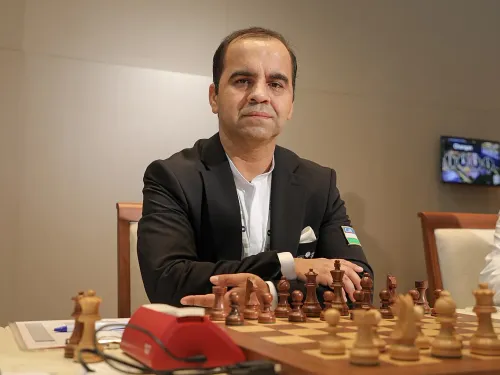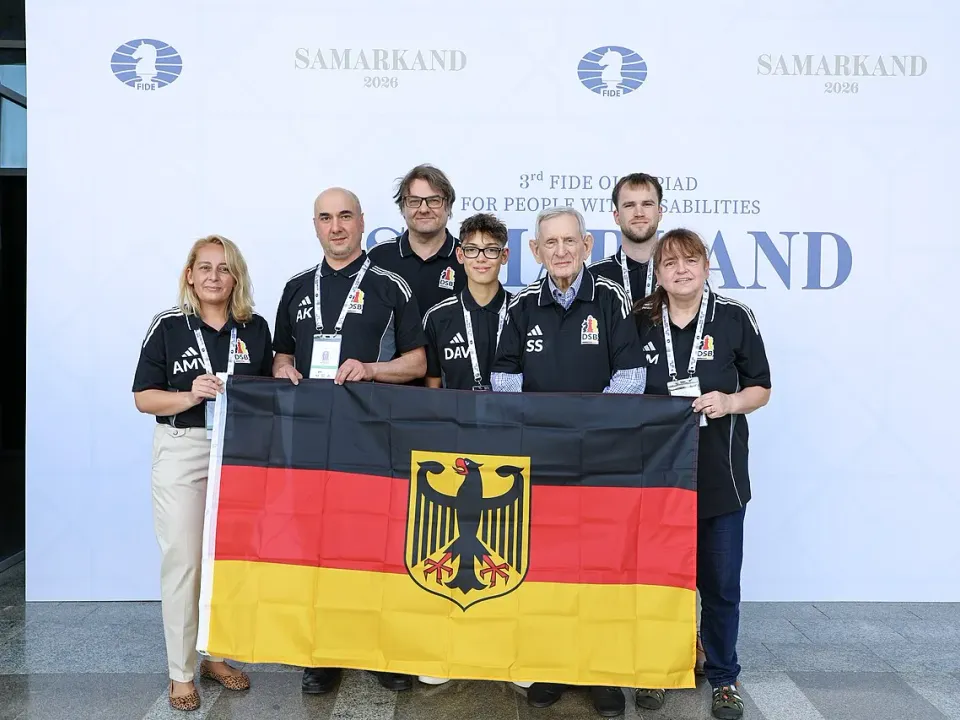
Round 2 of the 3rd FIDE Chess Olympiad for People with Disabilities produced a cluster of lopsided scorelines in Samarkand, and by the end of the day eight teams sat on a perfect four match points, setting up a round of direct collisions at the top of the table.
The results themselves were emphatic. Cuba beat Serbia 3-1 and Israel beat Ukraine by the same score, while IBCA ran out 3½-½ winners over Switzerland. Germany defeated Kazakhstan 3-1, the Philippines beat Hungary 3-1, and the Czech Republic saw off Kyrgyzstan 3-1.
India produced the biggest margin among the leading pack, beating Uzbekistan 3 by 3½-½, and Argentina added a 3-1 win over Spain. That left the Philippines, Cuba, Israel, Argentina, Czech Republic, IBCA, India and Germany all on four match points after two rounds.
Round 3 now puts every one of those eight teams directly in front of another. Philippines face Cuba on Board 1, with both sides carrying 6½ game points into the match. Israel, also on 6½, meet Argentina on Board 2, while Czech Republic-IBCA and India-Germany round out the top-four pairings. Whatever happens on those boards will start separating a field that has, so far, refused to separate itself.
The day opened with a ceremonial first move from Thomas Luether, Chairperson of the FIDE Commission for Players with Disabilities, alongside Khusen Mirzaevich Tukhtaev, Uzbekistan’s Deputy Governor for Youth Policy and Social Development for the Samarkand Region.
What makes this edition worth pausing on is simply how big it’s gotten.
Field size at the over-the-board version of this event has climbed every time it’s been held: 26 teams in Belgrade in 2023, 34 in Astana last October, and now a record 40 in Samarkand, run as a seven-round Swiss from September 10 to 17.
That trajectory is the real headline sitting underneath Round 2’s results, and it’s a story The Chess Herald has traced back to the event’s origins.
This year also marks the first time the Disability Olympiad has run in the same city and period as the main Chess Olympiad, giving Samarkand double duty as host. Egypt’s Lila Mohamed Amin, whose team hammered Kenya 4-0 in Round 2, said she was looking forward to seeing the world’s top players nearby for the first time: “I’m very excited to see so many top chess players here.”
Amin’s own path into the game started at four years old, taught by her father before a coach was brought in once he noticed she was good at it. “So we are really a chess family,” she said, adding that a leg condition has never gotten in the way of her chess: “When I play a game of chess, I forget about everything else.”
Argentina’s Santiago Jose Curia had a similarly personal story after his team’s 3-1 win over Spain kept their perfect record intact. He learned the moves from his father before joining his first club, Jaque Mate, and later Club Argentino. “Chess is my hobby, but it is also a very big part of my life,” he said, with Israel waiting for his team on Board 2 in Round 3.
Chile’s Cristian Gonzalez Astete, whose team beat Panama 3-1, framed the tournament’s growth in terms of who gets to be on the same stage rather than how many teams show up. “We have people with different kinds of disabilities competing together, players with physical disabilities, players who cannot see and players who cannot hear,” he said. “That is what inclusion is about.”
He also welcomed the overlap with the main Olympiad happening in the same city. “It creates a feeling of equality, and that is very important,” he said, before Round 3 sends four of chess’s leading disability federations straight at each other.
Original source: FIDE
Noticed an error in the article? Report it from here.