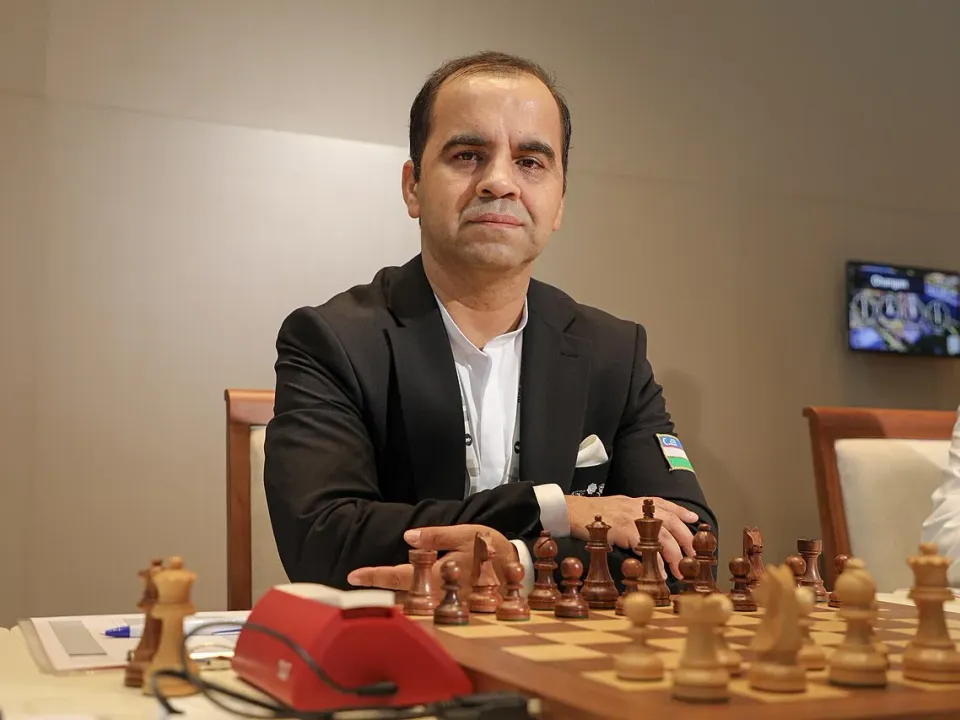
Sirojiddin Zaynidinov
Three teams now sit alone at the top of the 3rd FIDE Chess Olympiad for People with Disabilities in Samarkand, but the standings are only half the story coming out of Uzbekistan this week. Cuba, Israel and the Czech Republic emerged from Round 3 on 6/6, after eight teams had entered the day with perfect scores. Round 4 now pits Cuba against Israel directly, while the Czech Republic faces Germany.
Buried in that same day’s coverage is a coaching lineage that says more about the event’s purpose than any scoreline could. FM Sirojiddin Zaynidinov of Uzbekistan, a two-time world champion in deaf chess, is competing in Samarkand this week. Decades ago, a five-year-old named Javokhir Sindarov walked into his chess club.
Zaynidinov immediately recognized the boy’s potential and adapted his teaching to make it work, relying on visual explanations while Sindarov learned to read his coach’s speech and articulation. The results came fast. By age eight, Sindarov’s rating had already climbed to around 1900, and Zaynidinov recalled being certain the boy would become a grandmaster by twelve.
Sindarov eventually moved on to other coaches, but the foundation stuck, and so did the relationship. Zaynidinov said his former student still greets him warmly whenever their paths cross. This week, those paths cross again in Samarkand itself: Zaynidinov playing in the Disability Olympiad, Sindarov preparing for the 46th FIDE Chess Olympiad running alongside it.
That overlap is not an accident of scheduling. It is the entire premise behind holding the two Olympiads together in the first place, and it is worth remembering that this pairing is relatively new.
The Chess Herald has covered how this same disability event traces back to a much smaller first edition in Belgrade, before it grew into the kind of fixture that can sit on the same calendar as the main Olympiad and draw a record field, as previously reported.
Zaynidinov’s own journey mirrors that arc in miniature. He lost his hearing after an illness around age three, was introduced to chess by his father at five, and was often the only deaf child at his club growing up. He won a World Youth Championship in Germany in 2004 at fourteen, then another world title in Switzerland four years later.
What he did next is the part that connects directly to this week’s news. Rather than stop at his own titles, Zaynidinov said he wanted to teach others and produce champions of his own. Sindarov, now a fixture in the sport The Chess Herald has tracked as he faced Anand, is the clearest proof that the plan worked.
Not every story from Samarkand this week involves a name as recognizable as Sindarov’s. Mlandvo Khumalo of Team Eswatini is playing in his first FIDE Chess Olympiad for People with Disabilities, having lost both hands to illness in infancy and learning the game only after a secondary school teacher pushed him to try it.
He described the feeling of an opponent advancing a pawn as entering a kind of war, one he says he enjoys defending against.
Day 3 also opened with a panel on inclusion and technology, where GM Thomas Luther, chair of the FIDE Commission for Players with Disabilities, argued that AI and adaptive tools are raising what technology can do to level the playing field.
Jamie Kenmure, who chairs the Asian Commission for People with Disabilities, framed the day’s real purpose more simply: getting federations to listen to what players and their programs actually need. Round 4 will decide whether Cuba, Israel or the Czech Republic can keep pace at the front, but the coaching tree running through Zaynidinov’s club is the kind of result that outlasts any single Olympiad standing.
Original source: FIDE
Noticed an error in the article? Report it from here.