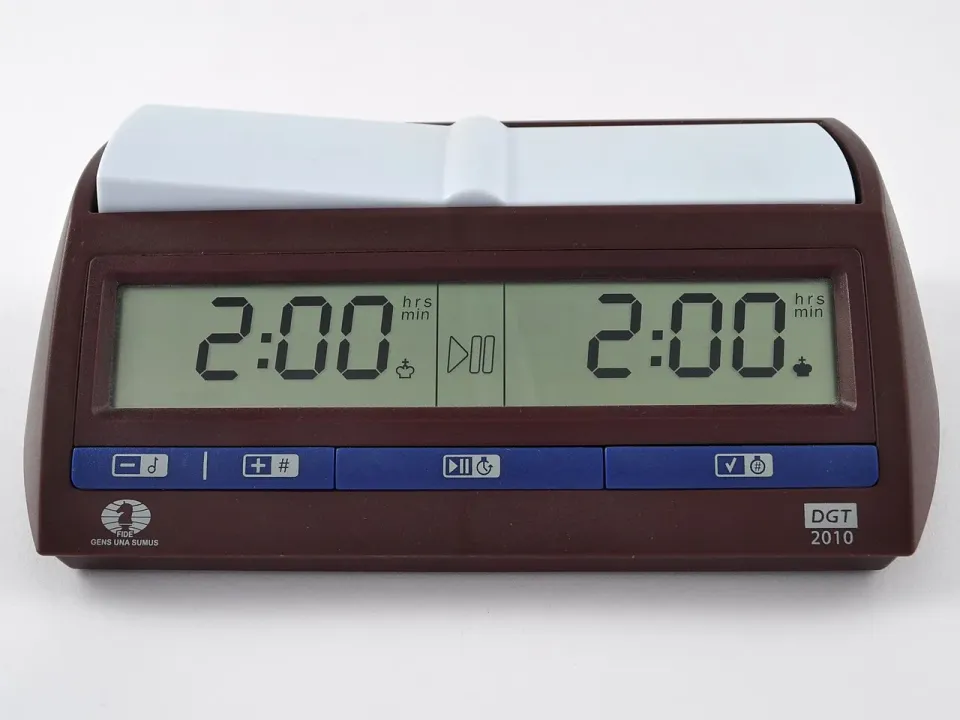
Every serious chess game is played against a clock, and the amount of time on it decides what kind of chess it is. FIDE splits games into three categories, each with its own rating.
The split is based on how long a 60-move game would take one player. Take the starting time and add 60 times the increment. Ten minutes or less is blitz. More than 10 but under 60 minutes is rapid, and 60 minutes or more is classical, also called standard.
The increment is time added to the clock after each move, and under FIDE rules it starts from move one. “90+30” means 90 minutes each plus 30 seconds per move. “3+2” is three minutes plus two seconds, a common blitz control.
Top classical events add a second layer. The 2026 World Championship match gives each player 120 minutes, then 30 more after move 40, with a 30-second increment from move 41. A single game can last six hours or more.
Rapid and blitz are often used to break ties. When a classical match or knockout round ends level, players move on to rapid games, then blitz. The World Rapid and Blitz Championships are separate titles of their own.
When even blitz doesn’t settle it, many events use an armageddon game. White gets more time, Black gets less, but a draw counts as a win for Black. Someone always wins.
The time split varies by event. Norway Chess, which plays an armageddon after every drawn classical game, has used 10 minutes for White and 7 for Black.
Time also shapes results. Many of the decisive moments in our reports come in time trouble, when a player has seconds left to find a move they would spot easily with an hour on the clock.
Original source: Wikipedia
Noticed an error in the article? Report it from here.