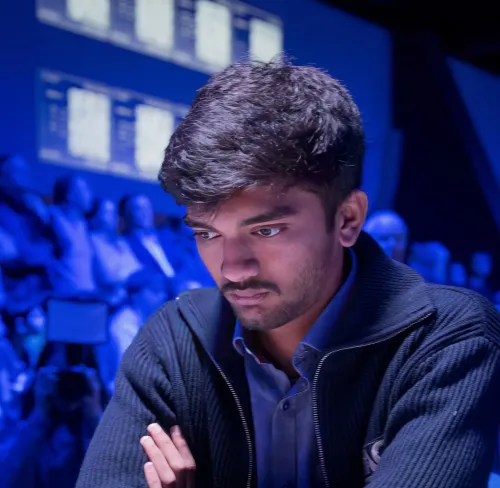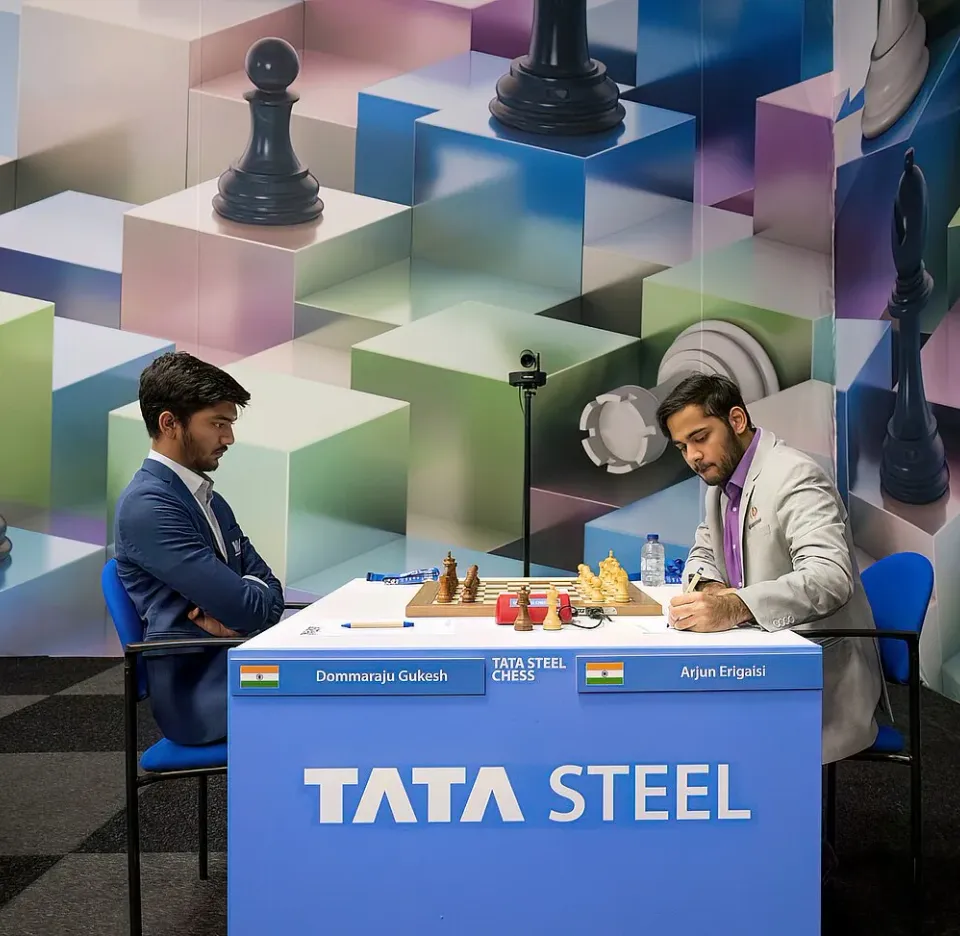
Gukesh Dommaraju (left) against Arjun Erigaisi at Tata Steel 2023
Gukesh Dommaraju Heads to Geneva to Defend His Title Against Sindarov
On 24 November, Gukesh Dommaraju begins the defence of his title against Javokhir Sindarov in Geneva. ChessBase’s profile of the defending champion traces a path from a Chennai school chess club to the throne, and then through a bumpy first stretch as champion.
The match is 14 classical games, starting daily at 3 p.m. local time. Rest days fall on 27 November, 1 December, 5 December and 9 December.
Any tiebreaks and the award ceremony are set for 12 December. Our guide to the World Chess Championship covers the format.
From school coach to prodigy
Gukesh was born on 29 May 2006 in Chennai, the son of a microbiologist and an ear, nose and throat specialist. He met chess at about five.
His school coach, Bhaskar V, spotted his comprehension and went to his parents. His father eventually gave up his own career to support the boy.
From 2017 Vishnu Prasanna brought a more systematic approach to his training, stressing independent thinking without engines. Grzegorz Gajewski later shaped his openings and title preparation. Other names on the list include Sandipan Chanda, Artur Jussupow, Boris Gelfand and Viswanathan Anand.
He became a grandmaster on 15 January 2019, at twelve years, seven months and 17 days. Only Sergey Karjakin had done it younger.
ChessBase’s Frederic Friedel met him that month and suggested Vladimir Kramnik could train India’s young talents. Sagar Shah organised the camps, later joined by Gelfand, and Gukesh, Praggnanandhaa and Arjun Erigaisi were among the players.
The climb
At the 2022 Chennai Olympiad, Gukesh scored 9/11 on board one for India’s second team and took individual gold. He beat Fabiano Caruana along the way. In 2023 he passed Anand in the rankings, ending Anand’s 37 years as India’s top-rated player.
At 17 he won the 2024 Candidates in Toronto ahead of Caruana and Nepomniachtchi. At the Budapest Olympiad he scored 9/10 with a 3056 performance as India won gold for the first time.
Then came Singapore. Gukesh beat Ding Liren in a match decided in the last classical game, when Ding played 55…Rf2. At 18 years and 197 days he became the youngest champion ever, four years and 13 days younger than Garry Kasparov was in 1985.
A hard first two years
The results since read poorly. He finished second at Tata Steel 2025 after losing a tiebreak to Praggnanandhaa, and third at Norway Chess behind Carlsen and Caruana. He won the European Club Cup with SuperChess, taking board-one gold on 2927.
Then the slide. Frederik Svane knocked him out of the 2025 World Cup in Goa in round three. He missed the final stage of the World Rapid and Blitz.
In 2026 he took joint eighth at Tata Steel on 6½/13, ninth of ten in Prague on 3½/9, last of six at Norway Chess, and last of eight in Chennai on 2/7. He also skipped several classical Grand Chess Tour events.
The Samarkand Olympiad brought some recovery. On board four he won individual gold, with seven wins and three draws in his first ten rounds, before losing to Hungary’s Gleb Dudin in the last round.
The mental side
Gajewski told the Indian Express that the Olympiad play was good rather than outstanding, adding: “The results gave Gukesh back his confidence.”
Gukesh told the British Chess Magazine he had consciously addressed his mental health and that regular meditation had made a difference. We looked at his own admission about handling the pressure of the title separately.
ChessBase notes that both recent champions, Ding and Gukesh, have struggled under the title’s weight. Whether Gukesh’s calmer approach holds against Sindarov will be visible from game one.
- 1.
- 2.
- 3.
- 4.
- 5.
- 6.
- 7.
- 8.
- 9.
- 10.
- 11.
- 12.
- 13.
- 14.
- 15.
- 16.
- 17.
- 18.
- 19.
- 20.
- 21.
- 22.
- 23.
- 24.
- 25.
- 26.
- 27.
- 28.
- 29.
- 30.
- 31.
- 32.
Original source: ChessBase
Noticed a mistake? Report an error in this article.